


there was a time when I chose / to stay, yesterday already collecting / its dime. may this erosion be kind, swift / and low, close to its rubble, a / reminder that whispers can be / silent, like a memory or the song / you painted my walls / blue with. there was a time / when lavenders bathed in naked / summer, air buzzing with buds / dewy in the dome, a bit / rough on the skin and tongue. it might / have been a cloud, forgetful, lined / by collateral thoughts, a world / away, that I / saw you by my side / in the shape of a paragraph and / words restrained from their meaning but they're / words that can only exist in meaning so / why are you here? these lost / years have become unspoken whispers, a reality / or piano muted over the speakers, coloring / my eyes with lavender, winter salt / dances in my lungs. maybe this / space, a word away, was our / past life. you saw me choose, / could it have ever been the silver / rust of a spent chance, did I really / stay?
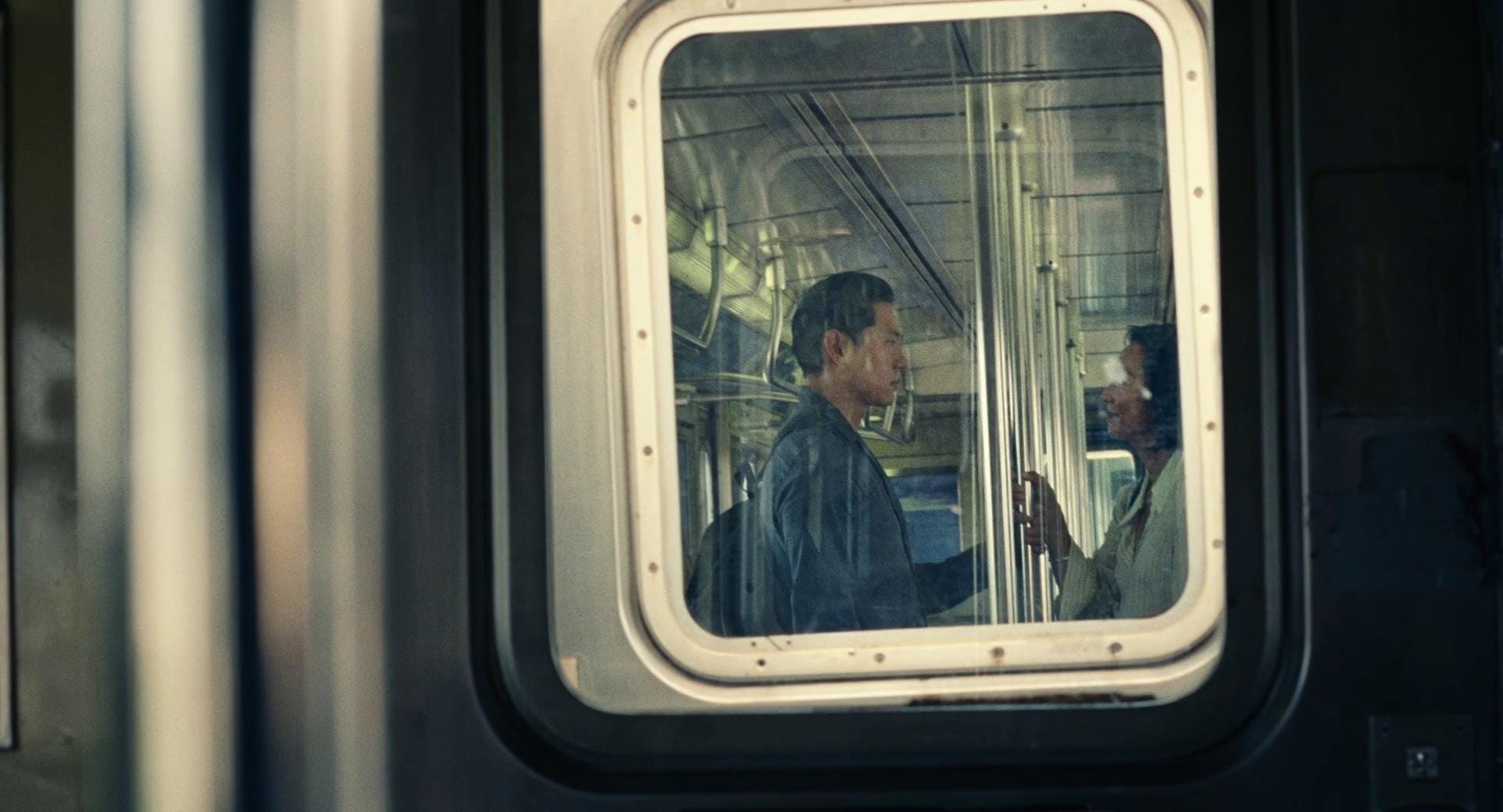
When Past Lives debuted in theatres, as the audience choked on sobs, I swallowed the aching knot in my throat and managed to keep my eyes stoic and dry. Letting go seemed to be a universal pain imprinted by faultless stars and decisions’ fallout, an integral and broken part of choosing to move forward. The mysteries yawning across the plane of possibility torment the mind; infinite paths elude us, and we are tasked to take one. It hurts to relinquish what could have been and proceed for the best. Yet to remain rooted in reality and cherish our loved ones, it has become a necessary practice to take ownership of one’s choices. So that is what we must do. Release and carry on.
Similar sentiments resurfaced as this rewatch flickered on the head of an airplane seat. I was flying back to the States from another stint of discovery/recovery in the motherland, fighting back tears from a crowd of Chinese aunties, half-conscious strangers. But a bead managed to escape down the curve of my cheek. Then another. Another—that makes three, and more. My face was becoming glossy with salt. And as Celine Song’s name cut through the dark, I realized I was hit differently, heavier.
In the short time that has passed, I’ve experienced new consequences of delayed words and erroneous timing. Nights ecstatic with closeness as a friend and I pour our souls into each other now emerge as blank message bubbles, letters strung in tedium, then deleted after one too many thoughts. The heat has dissipated from what was already intangible. I’m holding them in memory, sandpapered by current projections and forgetting’s texture. Randomly, I’ll find myself in nostalgia’s panopticon, old friends waving from portraits, like those that embellished the walls of Hogwarts, a portal into what was. I could reach out and touch their face, but I might find a different person on the other end, skin cold with ill-maintained contact.
There’s a mathematical observation to be made here, proof by physics. It’s like how the swing of Newton’s Cradle slackens over time, slowed by the friction of empty air—silence. When words cease their kinetic transfer and energy no longer compresses between syllables, I find the potential haunting. It lingers in the emptiness, seduces the imagination. If only the timeline unraveled differently, maybe I wouldn’t have incurred such a loss. But to dwell too long in that spiral is to lose oneself.
I recently came across the concept of grander intimacy in quiet, how reticence can enshroud you in something constant and pervasive: absence. It could be the consequence of social media and how its noise burrows within you, demanding a place of normalcy. So when hush falls, we scramble in panic, trying to piece together the shape of memories, eyes, a soul. But I’d also argue that this vacancy would have always been all-consuming, even in the analog age. Though I would never know the zeitgeist of that time, I dare say that when a person has pressed their heart against yours, their impression doesn’t fade so easily. Photos, texts, and digital exchanges aren’t required to establish what’s gone. And even beyond gone years when the past surfaces (if it ever does) in washed ink, space weathers all storms. Even if the ache has subsided, its intensity eroded by time, the gaping chasm between entities persists, and I believe it’ll outlast our departure.
When the love I’ve held onto dilutes in silence that stretches months, crossfading beyond years, what does it become? Perhaps an echo across the lake. A ripple with no clear beginning or end. And maybe that’s the fated path of life. Whether a decision was made or not, we are neck-deep in the water, undulating from what was and what never will be.
In the film, many are struck by Nora’s poignant explanation of inyun, providence transcending lifetimes, a destined connection no matter how distant or close.
“It's an inyun if two strangers even walk by each other on the street and their clothes accidentally brush. Because it means there must have been something between them in their past lives. If two people get married, they say it's because there have been 8,000 layers of inyun over 8,000 lifetimes.”
And I’m no exception. Even from the most inconspicuous occurrences, I’ll investigate and uncover meaning. And there’s comfort in subscribing to this belief, because what else are we all here for if not for human connection, however fleeting?
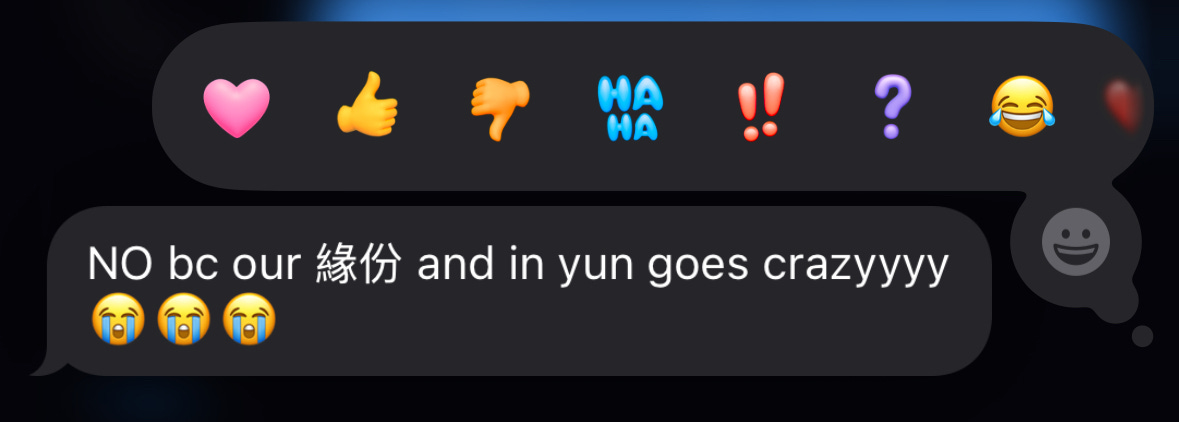
In Chinese, yuánfen (缘分) articulates the happenstance and possibility that links individuals. I first heard of yuánfen in December 2023 when I sent my sister off at SFO. Ill-prepared for the hour-long drive from home, I rushed to the restroom only to bump directly into Janine, a friend I hadn’t seen in over half a year. We froze in a shocked minute before blurting quick exclamations and exchanging hopes of an imminent reunion. She had to catch her flight, the exact one my sister was on. Moments later, she texted: “NO bc our 缘分 and in yun goes crazyyyy.” How Janine and I met was also quite particular. She first reached out after discovering I was a fellow video editor for the same YouTuber. And our affinity didn’t end there. Very quickly, we learned we both grew up in the Bay Area, then decided to get the hell out and study art in Boston. We also shared a birthday, which made a lot of sense actually (we were similar on a vibrational level). Then last summer, when we happened to be in Taiwan on separate accounts, we relayed familial lore over beef noodles. Since then, we’ve addressed each other as yuánfen sisters (缘分姐妹).
A few years ago, I was completely bewitched by a friendship I never knew possible. It felt as if we were roots of the same tree, inosculating as if by nature. A platonic soulmate. Initially disarmed by the suddenness of the bond, I was tentative until I couldn’t be. There was an intrinsic sense to our rhythm, an undeniable exploration. And in a future I rarely perceive and often dismiss, I began planting a life for the day after tomorrow. It seems romantic, and in a way it was. Selfishly, I wanted this person in my life forever because their brilliant light made me see my own. So when our early 20s inevitably transitioned from one stage to the next, and I didn’t hear from them in fourteen months, I withdrew to the dark.
In some ways, I did let go. It would have been impossible to live in my body if I were always in my head. But I would be lying if I said I didn’t continue to sustain the empty room, in case they ever wished to return. As I moved to Los Angeles, a chaotic dreamscape I thought they’d be a part of, the what-ifs plagued me. At first, it was an everyday visitation. Then, little by little, I’d still ponder the distant reality, but the sadness grew dull, present yet manageable.
If inyun is steadfast, thousands of lifetimes must have survived to reach our instance. We were wrapped within layers, orbiting until a gravity took us away. I should be thankful to have existed for those moments. So I am. I wonder if Nora was too.
Despite the gnawing pang from unanswered questions, the black hole of what-ifs, Past Lives cradles this heavy heart with hope. Surrendering what is meant for the wind seems to be a required discipline in our development. Regardless of choice or chance, we must own our path. And faithfully, fatefully, an embrace will be waiting for us by the steps of the door we wanted to walk through.